Difference Between Esr Magmouse and Geekom A5 2025 Edition Mini Pc Explained
The market for personal computing and accessories has become highly specialized. Two products that illustrate how different pieces of the computing puzzle address distinct user needs are the Esr Magmouse and the Geekom A5 2025 Edition Mini PC. One is a compact input device intended to improve daily interaction with a laptop or desktop, and the other is a small-form-factor computer designed to deliver desktop-class performance in a tiny footprint. This article breaks down the key differences between them, evaluates real-world use cases, and offers guidance for buyers who are deciding which — or which combination — makes the most sense for their setup.
Introduction: Why compare a mouse and a mini PC?
Comparing an input peripheral to a complete computing platform may seem odd at first. The point is practical: many buyers assemble their productivity or home office setups by mixing and matching devices. Understanding how the Esr Magmouse and the Geekom A5 2025 Edition complement or contrast one another helps readers prioritize spending, plan workspace ergonomics, and select the right tools for tasks ranging from web browsing and office work to light content creation and media streaming.
Esr Magmouse — Product analysis
The Esr Magmouse is positioned as a modern compact mouse targeting mobile professionals, hybrid workers, and anyone who values portability and simple multi-device workflows. It emphasizes convenience, battery life, and a low-friction pairing experience.

Design and ergonomics
The Magmouse favors a slim, low-profile silhouette intended to slide easily into a laptop bag. Where full-size ergonomic mice use pronounced contours to support the palm, the Magmouse leans toward a flatter, ambidextrous layout that suits fingertip and claw grips commonly used during travel. The surface materials are typically matte plastic with subtle texture to balance grip and portability.
Connectivity and compatibility
Esr aims this mouse at users who move between machines, so common connectivity options include Bluetooth multi-host pairing (switchable between two or three devices) and a 2.4 GHz USB receiver for legacy systems. Compatibility generally spans Windows, macOS, iPadOS, and many Linux distributions, though advanced features may be tailored for specific platforms.
Battery and charging
Battery expectations for a device in this class typically prioritize days or weeks of use on a single charge. The Magmouse is designed with energy-efficient sensors and an auto-sleep function. Charging may be via USB-C; some models in the market now incorporate magnetic charging docks or MagSafe-style attachments to appeal to laptop users who already use magnetic accessories.
Performance and sensors
For typical office workflows, web browsing, and light photo editing, the Magmouse's sensor provides reliable tracking from around 1000 to 4000 DPI with adjustable steps. The click feel is tuned for quiet office environments, and the scroll wheel is engineered for a mix of tactile steps and smooth scrolling. High-frame-rate gaming is not the intended use case — there are better dedicated gaming mice — but the Magmouse performs well for task-focused work.
Real-world use cases
- Commuters who need a compact, easy-to-stow mouse for laptops.
- Hybrid workers switching between a work laptop, personal tablet, and home desktop.
- Users who value simple multi-device pairing without bulky dongles.
- Students and presenters who need a reliable pointing device for slides and annotations.
Esr Magmouse — Pros & Cons
- Pros:
- Highly portable design that fits easily into laptop bags.
- Simple multi-device pairing and broadly compatible connectivity.
- Long battery life with energy-saving features.
- Quiet clicks and refined scroll for office environments.
- Cons:
- Not optimized for extended ergonomic comfort for large-handed users.
- Limited customization compared with full-featured mice (fewer buttons, profiles).
- Not a gaming-focused sensor; limited for fast-paced competitive play.
Geekom A5 2025 Edition Mini PC — Product analysis
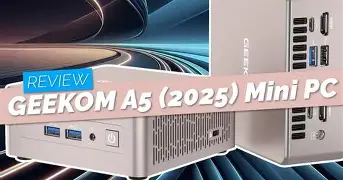
The Geekom A5 2025 Edition Mini PC is a compact desktop replacement designed for users who want the power of a desktop without the physical footprint. Geekom's mini PCs are generally aimed at home offices, media centers, digital signage, and light workstation tasks where space, noise, and energy efficiency matter alongside capable CPU and GPU performance.
Design and build
The A5 retains the small rectangular chassis common to mini PCs and includes mounting points compatible with VESA arms or monitor backs. The 2025 Edition typically refreshes internal components and may refine thermal layout to sustain higher sustained loads while keeping fan noise modest. Build quality tends to favor metal or metal-and-plastic combinations to aid heat dissipation.
Discover deals on Laptops & Computers — updated daily.
View Offers →Internal specifications and performance
Geekom's 2025 update targets a blend of multi-threaded CPU performance and modern integrated graphics. Configurations typically offer mid-range mobile-class processors, a choice of RAM up to 32GB or more, and NVMe SSD storage. For many users the A5 replaces larger desktops for tasks such as office productivity, web development, 1080p video editing, light photo editing, and media streaming.
I/O and expandability
One of the main selling points of mini PCs is port density. The A5 2025 Edition usually provides a mix of USB-A and USB-C ports, HDMI and DisplayPort outputs for multi-monitor setups, Gigabit Ethernet, Wi‑Fi 6/6E, and a 3.5mm audio jack. Some models include M.2 slots for upgrading storage and SO-DIMM slots for RAM upgrades, while others use soldered RAM depending on the SKU — buyers should confirm the exact configuration.
Power, thermals and noise
Geekom focuses on maintaining a low acoustic profile. The A5 is designed to run quietly at idle and ramp fans intelligently under load. Power draw depends on the chosen CPU, but mini PCs in this category are significantly more power efficient than full-sized desktops, making them well-suited for always-on use.
Real-world use cases
- Home office users needing a compact machine for productivity, web conferencing, and multitasking.
- Small business…
Feature Esr Magmouse Geekom A5 2025 Edition Mini PC Product type Portable input device (mouse) Small-form-factor desktop computer Main purpose Pointing/navigation, portability, multi-device control Compute platform for productivity, media, and light creation Primary users Mobile professionals, students, presenters Home office users, small business, media center enthusiasts Connectivity Bluetooth, 2.4 GHz receiver (USB), USB-C charging Ethernet, Wi‑Fi 6/6E, Bluetooth, multiple USB ports, HDMI/DP Performance Input responsiveness and battery efficiency CPU/GPU performance dependent on configuration (desktop workloads) Upgradeability None (peripheral) RAM and storage may be upgradeable depending on SKU Portability Very high (fits in pocket or small bag pocket) High for a PC but requires a bag and power supply Price role Accessory-level spend Primary hardware investment (varies with configuration) Typical lifespan 3–5 years depending on usage and build 3–6+ years depending on configuration and workload How buyers typically decide: Real-world concerns
When comparing peripheral purchases like the Magmouse to system purchases like the Geekom A5, buyers balance distinct priorities:
- Budget allocation: A quality mouse is a relatively small investment compared with a mini PC. Buyers decide whether improving input ergonomics is the priority or whether system-level upgrades are needed first.
- Space and portability: For limited desks or for people who travel often, the compactness of both products is attractive. The mouse addresses immediate mobility; the mini PC reduces desk clutter while staying stationary.
- Performance needs: If tasks are CPU- or GPU-bound (video rendering, compilation, virtual machines), budget toward a more powerful system like the A5. For improved day-to-day comfort and efficiency, the Magmouse may give a larger perceived productivity boost.
- Interoperability: Multi-device households benefit from peripherals that easily pair with tablets and phones — a point in favor of a multi-host mouse. Conversely, a mini PC must integrate into the home network and peripherals ecosystem.
- Longevity and upgradability: Mini PCs can sometimes be upgraded and repurposed, stretching their value. Mice are consumables that may be replaced more frequently but are less costly to replace.
Buying guide: What to consider before choosing
Choosing between these devices isn't an either-or decision in many cases; they fulfill different roles. Use the checklist below to prioritize purchase decisions and configurations.
1. Identify the primary pain point
If the current issue is wrist strain, unresponsive controls, or slow transitions between devices, a better mouse like the Esr Magmouse directly addresses those problems. If the complaint is slow multitasking, long renders, or limited connectivity and ports on a laptop, investing in the Geekom A5 will yield more system-level improvements.
2. Consider the workspace and mobility
Measure desk space, travel frequency, and whether a VESA-mounted mini PC would keep a workspace tidy. For people who work mostly in cafes or travel, prioritize a lightweight portable mouse. For those with fixed desks, the A5 reduces clutter and can centralize connectivity.
Find top-rated Laptops & Computers products at great prices.
Shop Amazon →3. Evaluate upgrade paths and configuration options
When buying a mini PC, confirm whether RAM and storage are user-upgradeable. If the use case may evolve (more video editing, heavier multitasking), prioritizing upgradeable SKUs is wise. For mice, consider replaceable batteries versus built-in rechargeable cells depending on longevity preferences.
4. Check platform compatibility and drivers
Confirm that advanced functionality (custom buttons, DPI switching, gesture support) is supported on the buyer's OS. Some mice offer Mac-specific gestures or software that only runs on Windows. Similarly, ensure the mini PC’s OS licensing (Windows, Linux, or no OS) matches the buyer’s needs.
5. Think about peripheral ecosystem
Buying a new mouse often prompts assessment of the keyboard, monitor, and docking situation. If the Geekom A5 will be the core of a new setup, plan for cables, docking, and display configurations ahead of time to avoid compatibility surprises.
6. Noise, thermals, and environment
For quiet environments (recording, meeting-heavy schedules), check the mini PC’s fan noise and thermal management. The Magmouse generally has no thermal implications, but battery charging and power management might matter in shared spaces where frequent charging plates are used.
7. Realistic expectations for gaming and content creation
Neither the Magmouse nor an integrated-graphics mini PC will replace a high-end gaming rig or a workstation with discrete GPUs for heavy 3D or large-scale video projects. Buyers who occasionally game or edit short videos will find either product satisfactory; professionals should look toward more specialized hardware.
Recommended buyer scenarios
- Remote worker with a laptop as main device: Start with the Esr Magmouse to improve daily comfort and device-switching efficiency. Consider the Geekom A5 later if the laptop no longer meets performance needs at a fixed workspace.
- Home office looking to replace a bulky tower: The Geekom A5 2025 Edition makes a compelling compact replacement. Pair it with a comfortable mouse (such as the Magmouse or a larger ergonomic option) for a balanced setup.
- Media center or living-room PC: Choose the A5 for quiet streaming and playback. A compact wireless mouse is a useful accessory for occasional navigation from the couch.
- Student or presenter: A lightweight Magmouse provides portability and practical features for campus life; a mini PC might be unnecessary unless heavy processing is required.
Conclusion
The Esr Magmouse and the Geekom A5 2025 Edition Mini PC occupy different layers of a computing setup. The Magmouse is an accessory designed to make interaction with existing devices smoother, more portable, and more efficient. The Geekom A5 is a compact computing platform intended to replace or supplement a traditional desktop with a modern, space-saving alternative. Buyers should prioritize the device that addresses their immediate bottleneck: ergonomics and mobility for the mouse, system performance and connectivity for the mini PC. In many cases, the most effective setup combines both — a compact, powerful mini PC anchored to a workstation and a comfortable, portable mouse for flexible control.