Don't Buy the Samsung Qn90F Neo QLED TV Until You Read This Full Analysis
Selecting a new flagship television has become an increasingly complex endeavor as the boundaries between different panel technologies continue to blur. For years, the debate was simple: choose OLED for perfect blacks and infinite contrast, or choose LED-LCD for high peak brightness and room-filling vibrance. However, the introduction of Mini-LED technology—marketed by Samsung as Neo QLED—has fundamentally shifted this dynamic. The Samsung QN90F Neo QLED TV represents the latest iteration of this high-performance middle ground, promising to deliver the best of both worlds. But before you commit a significant portion of your home theater budget to this specific model, it is essential to understand where it excels and where it might fall short of your specific viewing requirements.
The QN90F occupies a critical position in the Samsung lineup. It is designed to be the "hero" 4K model—the television for people who want the absolute best performance without making the jump to the exponentially more expensive 8K territory or the still-maturing QD-OLED options in larger sizes. This analysis explores the technical architecture of the QN90F, its real-world performance across various lighting conditions, and how its software ecosystem impacts the daily user experience. In a market saturated with marketing jargon like "Quantum Matrix Technology" and "Neural Quantum Processor," this guide aims to strip away the hype and provide a clear-eyed look at what actually happens when the lights go down and the movie starts.
The Technical Foundation: Understanding Neo QLED and Mini-LED
To understand the QN90F, one must first understand the "Neo" in Neo QLED. Traditional LED televisions use a backlight composed of standard-sized light-emitting diodes. These LEDs are relatively large, which limits the number of "dimming zones" the TV can have. When a TV has fewer zones, it struggles to keep bright objects from "bleeding" into dark areas—a phenomenon known as blooming. The QN90F utilizes Mini-LEDs, which are roughly 1/40th the size of conventional LEDs. This allows Samsung to pack thousands of light sources into the same surface area, controlled by a sophisticated Quantum Matrix. This increased density provides much more granular control over light, allowing for deep, ink-like blacks that rival OLED while maintaining the staggering brightness that LED technology is known for.
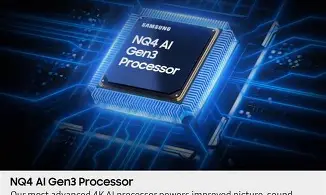
Powering this hardware is the latest Neural Quantum Processor. While many manufacturers focus solely on resolution, Samsung’s processor focuses on texture, noise reduction, and smart upscaling. The AI-driven engine analyzes incoming signals frame-by-frame, using multiple neural networks to reconstruct details that might be lost in lower-resolution content. For a buyer who still watches a fair amount of broadcast television or older streaming titles, this upscaling capability is often more important than the raw panel specs themselves. The QN90F isn't just showing you a picture; it is actively interpreting and enhancing it in real-time.
Picture Quality Analysis: Brightness, Contrast, and Color
The most immediate impression the QN90F makes is one of sheer luminous power. In an era where 1,000 nits was once considered the gold standard for HDR (High Dynamic Range), the QN90F pushes significantly higher. This makes it an ideal candidate for rooms with significant natural light. If you have a living room with floor-to-ceiling windows or if you frequently watch sports during the afternoon, this TV will easily cut through glare that would wash out almost any OLED on the market. The anti-reflective coating on the panel is also world-class, diffusing direct light reflections into a duller, less distracting haze rather than reflecting sharp, mirror-like images of your lamps or windows.
However, brightness is only half the story. Contrast is the true measure of a high-end display. Thanks to the improved dimming algorithms in the QN90F, the "blooming" issues that plagued earlier Mini-LED models have been significantly mitigated. When watching a scene of a starfield or a dark hallway with a single candle, the transition from light to dark is impressively sharp. There is still a trace amount of light bleed if you view the TV from an extreme side angle, but from the primary seating position, the contrast is nothing short of breathtaking. The "blacks" are so deep that they effectively disappear into the bezel of the frame in a darkened room.
Color reproduction on the QN90F is handled by a layer of Quantum Dots. These nano-particles react to light by emitting very specific wavelengths, resulting in a color volume that is more "saturated" than traditional filtered LEDs. In practice, this means that even at high brightness levels, colors remain vivid and true rather than looking "washed out." For HDR content, specifically in HDR10+, the QN90F produces a range of reds, greens, and blues that feel cinematic and organic. It should be noted, however, that Samsung still does not support Dolby Vision. While HDR10+ is an excellent dynamic metadata format, Dolby Vision is more prevalent across streaming services like Netflix and Disney+. For the average viewer, the TV’s internal tone mapping compensates well enough that this isn't a dealbreaker, but for the purist, it remains a notable omission.
Gaming Performance and Connectivity
For many modern buyers, a television is as much a gaming monitor as it is a movie screen. The QN90F excels in this department, perhaps more than any of its competitors. It features four full-bandwidth HDMI 2.1 ports, which is a critical feature for those who own both a PlayStation 5 and an Xbox Series X, alongside a high-end soundbar. Many other manufacturers only offer two such ports, often forcing users to choose which device gets the "best" connection. The QN90F supports 4K gaming at up to 144Hz (on certain models/PC inputs), Variable Refresh Rate (VRR), and Auto Low Latency Mode (ALLM).
Looking for the best TVs & Home Theater deals on Amazon?
View Offers →Samsung’s Gaming Hub software is another highlight. It integrates cloud gaming services like Xbox Game Pass and NVIDIA GeForce NOW directly into the TV's menu system, allowing you to play high-end games without a console at all—provided you have a fast internet connection and a Bluetooth controller. The input lag is virtually imperceptible in "Game Mode," measuring under 10 milliseconds, which puts it in the same tier as dedicated gaming monitors. The "Game Bar" provides a quick-access overlay to check frame rates, HDR status, and adjust image settings without leaving the game. For the competitive gamer or the enthusiast hobbyist, the QN90F is arguably the most versatile display currently available.
Design, Build Quality, and the Tizen OS
Aesthetically, the QN90F follows Samsung’s "NeoSlim" design philosophy. The profile is remarkably thin from top to bottom, making it an excellent candidate for wall mounting. Unlike some TVs that have a "bulge" at the bottom to house the speakers and electronics, the QN90F is uniform. The stand is a heavy, centered hexagonal plate that provides excellent stability and allows the TV to fit on narrower media consoles. The build quality feels premium, with tight tolerances and high-quality plastics and metals used throughout.
The user experience is governed by the Tizen Smart OS. In recent years, Tizen has shifted toward a full-screen interface that prioritizes content recommendation…
Audio Performance: Object Tracking Sound+
Most thin-panel TVs struggle with audio, as there simply isn't enough physical space for large drivers to move air. Samsung attempts to solve this with "Object Tracking Sound+" (OTS+). This system uses multiple speakers located around the frame of the TV to project sound that seems to follow the action on the screen. If a car drives from left to right, the audio follows that trajectory. While the spatial imaging is impressive for integrated speakers, the low-end performance is predictably lacking. There is no real "thump" for explosions or deep bass in music. For an entry-level experience, the speakers are above average, but a TV of this caliber truly demands a dedicated soundbar or a full surround sound system to match the scale of the visual performance.
Comparison and Analysis
To better understand how the QN90F sits within the current market, it is helpful to look at how its specifications translate to real-world performance metrics compared to other popular technologies.
| Feature | Samsung QN90F (Neo QLED) | Standard High-End OLED | Mid-Range LED-LCD |
|---|---|---|---|
| Peak Brightness | Very High (2000+ nits) | Moderate (800-1200 nits) | Low to Moderate (400-800 nits) |
| Contrast Ratio | Exceptional (Mini-LED) | Infinite (Per-pixel) | Average (Local Dimming) |
| Black Levels | Very Deep (Little blooming) | Perfect (No blooming) | Noticeable Gray/Glow |
| Color Volume | High (Quantum Dots) | Excellent (White or QD-OLED) | Standard |
| Gaming Ports | 4x HDMI 2.1 | Often 4x HDMI 2.1 | Usually 2x HDMI 2.1 |
| Daylight Visibility | Excellent | Good (but prone to glare) | Fair to Good |
Pros and Cons: A Summary for the Decisive Buyer
Every technology involves trade-offs. The Samsung QN90F is a powerhouse, but it may not be the perfect fit for everyone. Below is a breakdown of the key advantages and drawbacks observed during our analysis.
- Pro: Class-Leading Brightness – The QN90F is one of the few televisions that can truly fight off direct sunlight and provide a vivid HDR experience in bright rooms.
- Pro: Exceptional Gaming Features – With 144Hz support, four HDMI 2.1 ports, and a dedicated Gaming Hub, this is a top-tier choice for console and PC gamers.
- Pro: Minimalist Design – The ultra-slim profile and premium build quality ensure that the TV looks as good off as it does when it is on.
- Pro: Advanced Upscaling – The AI-driven processor does a remarkable job of making standard-definition and HD content look sharp and modern.
- Con: No Dolby Vision Support – Samsung continues to shun this popular HDR format in favor of its own HDR10+ standard, which may irritate enthusiasts.
- Con: Off-Angle Viewing – While better than standard LED TVs, the image loses some contrast and color accuracy if you are sitting far to the side of the screen.
- Con: Content-Heavy Interface – The Tizen OS can feel cluttered and sometimes slow to respond when navigating the home screen full of recommendations.
- Con: Premium Price Tag – As a flagship 4K model, the QN90F commands a high price that often overlaps with high-quality OLED options.
Buying Guide: Is the QN90F Right for You?
Deciding whether or not to purchase the Samsung QN90F depends largely on your viewing environment and the type of content you consume most frequently. It is helpful to categorize buyers into three distinct groups to see where this television fits.
Looking for the best TVs & Home Theater deals on Amazon?
See Deals →The Living Room Enthusiast
If your television is located in a main living area that has a lot of windows, lamp light, or high foot traffic during the day, the QN90F is likely your best option. OLED TVs, while stunning, often lack the raw luminance necessary to compete with a sun-drenched room. The QN90F’s ability to output massive amounts of light while simultaneously managing reflections means you won't have to close the curtains just to watch the news or an afternoon football game. For this user, the QN90F isn't just a choice; it's a practical necessity for visibility.
The Hardcore Gamer
For those who prioritize frame rates and connectivity, the QN90F offers a level of future-proofing that is hard to beat. The presence of four HDMI 2.1 ports means you can have a Soundbar (eARC), a PS5, an Xbox, and a PC all connected at once without ever swapping cables. The low input lag and support for G-Sync and FreeSync ensure that your gaming experience is smooth and tear-free. If you are worried about the "burn-in" potential of OLED screens (which can occur if static HUD elements from games are displayed for thousands of hours), the Neo QLED QN90F offers total peace of mind with its more durable LED structure.
The Movie Purist
If you primarily watch movies in a dedicated, light-controlled "man cave" or home theater and you demand perfect black levels for 4K Blu-rays, the choice becomes more difficult. While the QN90F has incredible contrast, it cannot technically achieve the per-pixel light control of an OLED. In very rare, high-contrast scenes, you might see a slight dimming of small highlights as the TV tries to prevent blooming. If you are the type of viewer who counts pixels and looks for imperfections in the shadows, you might still prefer an OLED model in a dark room. However, for 95% of viewers, the QN90F is so close to perfect that the difference is negligible.
Final Verdict and Conclusion
The Samsung QN90F Neo QLED TV is an undeniable triumph of engineering. It successfully pushes the boundaries of what LED-LCD technology can do, narrowing the gap between "backlit" and "emissive" displays to a razor-thin margin. By leveraging Mini-LEDs and sophisticated AI processing, Samsung has created a television that is as versatile as it is powerful. It is a chameleon of a display—equally at home in a bright sunroom as it is in a dark bedroom, and equally capable of handling a fast-paced shooter game as it is a slow-burn cinematic masterpiece.
Is it a "perfect" TV? Not quite. The lack of Dolby Vision remains a point of contention for HDR enthusiasts, and the Tizen interface can be a bit overwhelming for those who prefer a simpler, more streamlined smart TV experience. Furthermore, the price point puts it in direct competition with some truly excellent OLED displays, meaning buyers have to decide if they value peak brightness over "perfect" blacks. But for the vast majority of consumers who want a premium, high-performance television that works brilliantly in every scenario without the fragility of OLED, the QN90F is a premier choice. It is a bright, bold, and beautiful statement piece that proves that LED technology still has plenty of room to innovate.